
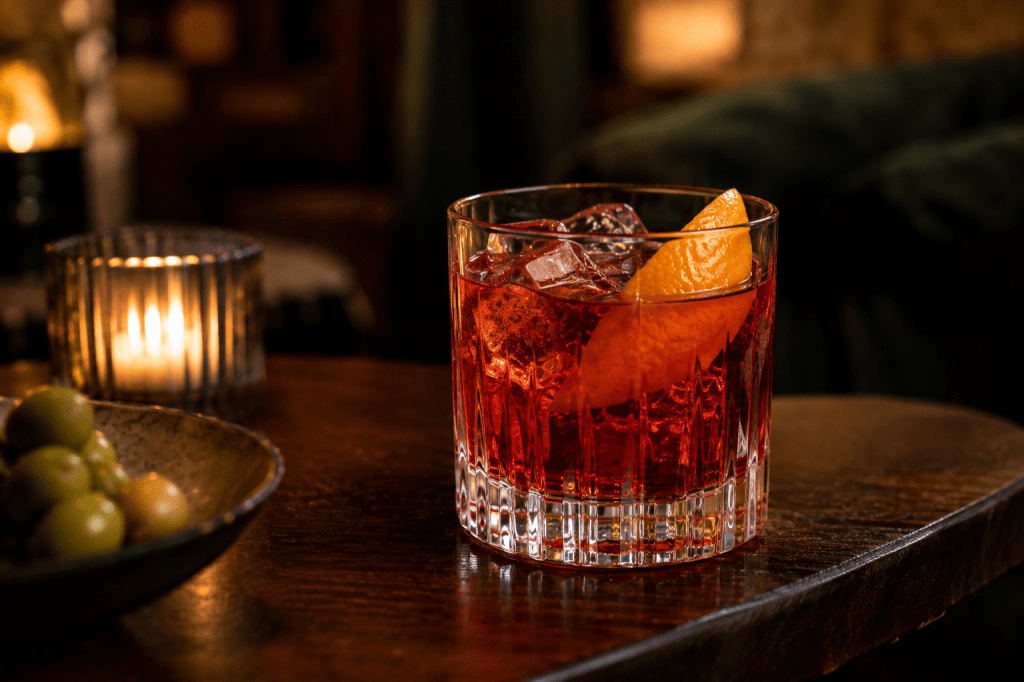
Among classic cocktails, few drinks have achieved the cultural permanence of the Negroni. Bitter, aromatic, and structurally simple, the Negroni has evolved from an Italian aperitivo into one of the defining cocktails of modern bartending. Its endurance comes from balance: equal parts spirit, bitterness, sweetness, and botanical complexity. Yet the Negroni’s story is also one of inclusion and adaptation — a cocktail continuously reinterpreted across cultures, ingredients, and drinking traditions.
Origins of the Negroni
The accepted origin story places the Negroni in Florence, Italy, around 1919. According to historical accounts, Count Camillo Negroni requested a stronger version of the Americano cocktail at Caffè Casoni. The bartender reportedly replaced the soda water with gin, producing a richer and more spirit-forward drink.
The original Americano consisted of:
- Campari
- Sweet vermouth
- Soda water
By substituting gin for soda, the cocktail gained structure, dryness, and alcoholic strength while preserving the bittersweet profile that defined Italian aperitivo culture. The drink rapidly spread through Italy and eventually internationally, especially after the expansion of Italian spirits brands in the mid-20th century.
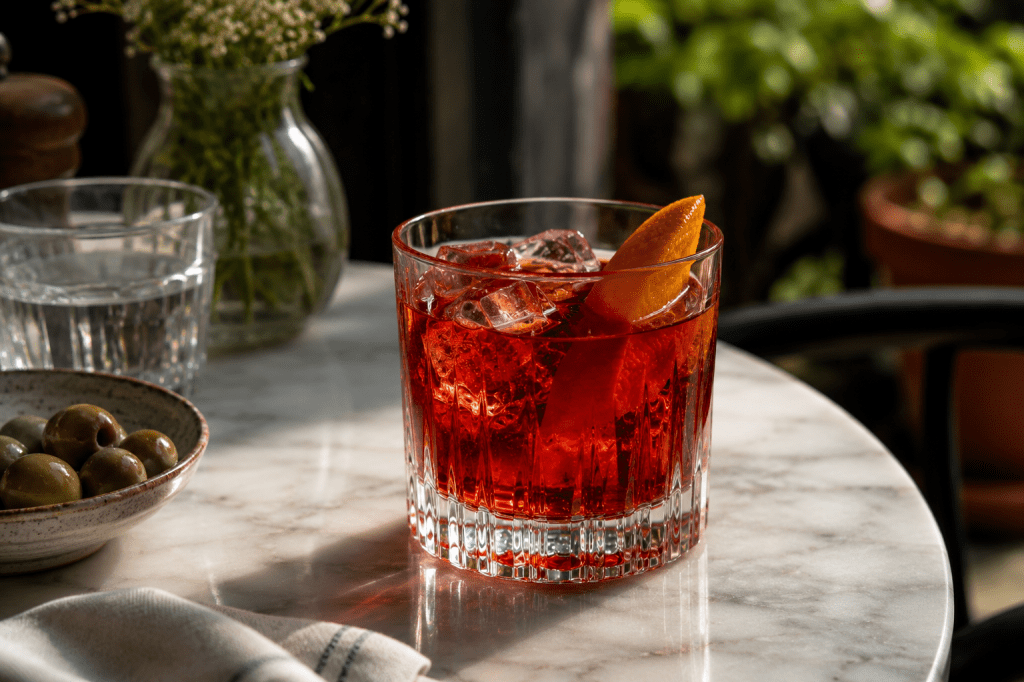
The meaning of inclusion in Negroni culture
The Negroni has become unusually inclusive within cocktail culture for several reasons:
Simplicity
The canonical equal-parts structure makes it approachable for both professionals and home bartenders. It requires no obscure technique and scales easily.
Flexibility
Unlike rigid classic cocktails, the Negroni welcomes substitution:
- Bourbon instead of gin
- Mezcal instead of gin
- Aperol instead of Campari
- Different vermouth styles
- Alternative amaros
Global adaptation
The Negroni now exists in:
- Japanese high-end cocktail bars
- American craft cocktail programs
- Latin American mezcal bars
- Scandinavian minimal cocktail culture
Each region modifies bitterness, sweetness, and aromatics according to local taste.
Modern cocktail revival
During the 2000s craft cocktail renaissance, bartenders embraced the Negroni because it:
- showcased premium spirits,
- highlighted bitter flavors,
- encouraged balance rather than excessive sweetness
The Classic Negroni
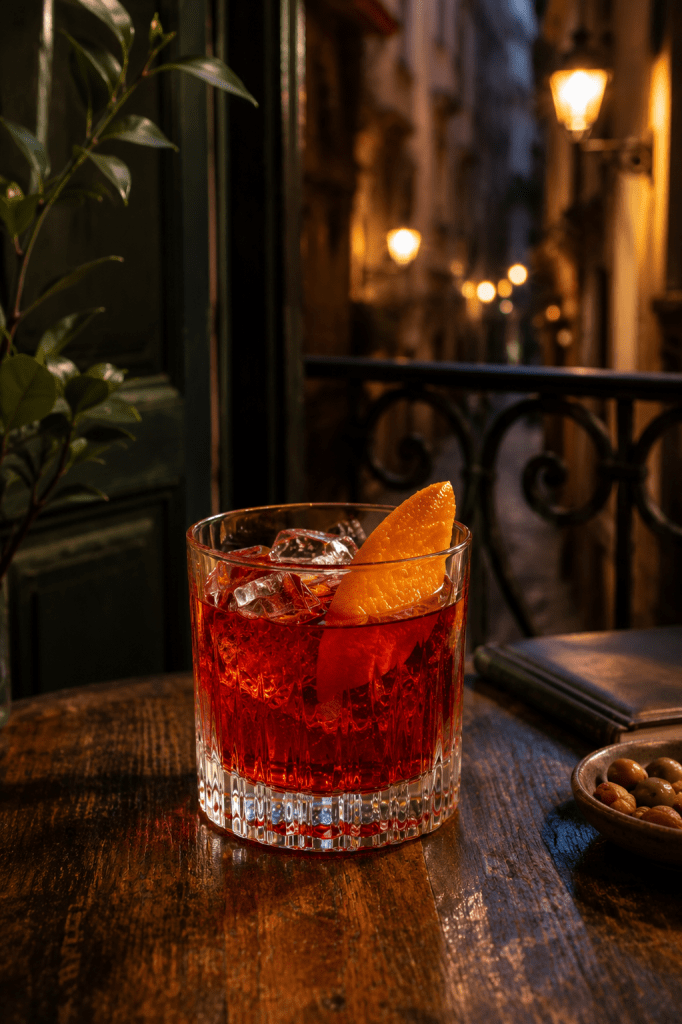
Ingredients
- 30 ml gin/ 1 oz gin
- 30 ml Campari/ 1 oz Campari
- 30 ml sweet vermouth/ 1 oz sweet vermouth
Method
- Add all ingredients to a mixing glass with ice.
- Stir until chilled and diluted.
- Strain over fresh ice in a rocks glass.
- Garnish with an orange peel.
Flavor profile
- Bitter
- Herbal
- Citrus-forward
- Sweet but dry-finishing
Historical evolution of the Negroni
1920s–1950s: Italian aperitivo tradition
Initially, the Negroni remained primarily an Italian café cocktail. Campari advertising and tourism gradually increased its visibility abroad.
1960s–1980s: International recognition
The cocktail became a staple in hotel bars and European lounges. However, sweeter cocktails often overshadowed bitter aperitifs during this era.
1990s–2000s: Craft cocktail revival
Bartenders rediscovered pre-Prohibition and European classics. The Negroni became central to cocktail education because it teaches: balance, dilution, bitterness, ingredient interplay.
2010s–Present: Experimental era
Modern bartenders expanded the format dramatically:
- barrel-aged Negronis,
- white Negronis,
- coffee Negronis,
- tropical Negronis,
- low-ABV versions,
- non-alcoholic adaptations.
The Negroni evolved from a single cocktail into an entire structural category.
Major Negroni variations
1. Boulevardier
The Boulevardier replaces gin with bourbon or rye whiskey.
Recipe
- 45 ml bourbon or rye whiskey/ 1.5 oz bourbon or rye
- 30 ml Campari/ 1 oz Campari
- 30 ml sweet vermouth/ 1 oz sweet vermouth
Flavor profile
- Richer
- Warmer
- Less botanical
- More caramel and spice
2. White Negroni
Created by British bartender Wayne Collins in the early 2000s.
Recipe
- 30 ml gin/ 1 oz gin
- 30 ml Suze/ 1 oz Suze
- 30 ml Lillet Blanc/ 1 oz Lillet Blanc
Flavor profile
- Floral
- Gentian bitterness
- Lighter citrus
- Earthier finish
3. Negroni Sbagliato
The Negroni Sbagliato emerged accidentally in Milan when sparkling wine was used instead of gin.
“Sbagliato” means “mistaken” or “wrong” in Italian.
Recipe
- 30 ml Campari/ 1 oz Campari
- 30 ml sweet vermouth/ 1 oz sweet vermouth
- 30 ml prosecco/ 1 oz prosecco
Flavor profile
- Lighter
- Effervescent
- Lower alcohol
- Brighter texture
4. Mezcal Negroni
A modern variation emphasizing smoke and earthy complexity.
Recipe
- 30 ml mezcal/ 1 oz mezcal
- 30 ml Campari/ 1 oz Campari
- 30 ml sweet vermouth/ 1 oz sweet vermouth
Flavor profile
- Smoky
- Savory
- Earthy
- Long bitter finish
5. Old Pal
The Old Pal is structurally similar to the Boulevardier but uses dry vermouth.
Recipe
- 30 ml rye whiskey/ 1 oz Rye whiskey
- 30 ml Campari/ 1 oz Campari
- 30 ml dry vermouth/ 1 oz dry vermouth
Flavor profile
- Drier
- Sharper
- More spice-forward
- Less sweetness
6. Coffee Negroni
A contemporary specialty cocktail often using coffee liqueur or cold brew concentrate.
Recipe
- 30 ml gin/ 1 oz gin
- 20 ml Campari/ 0.75 oz Campari
- 20 ml sweet vermouth/ 0.75 oz sweet vermouth
- 20 ml coffee liqueur/ 0.75 oz coffee liqueur
Flavor profile
- Roasted
- Bitter-chocolate notes
- Rich texture
- Espresso aromatics
7. Tropical Negroni
A fruit-forward interpretation popular in modern tiki-influenced bars.
Recipe
- 30 ml gin/ 1 oz gin
- 30 ml Aperol/ 1 oz Apero;
- 30 ml pineapple-infused vermouth/ 1 oz pineapple-infused vermouth
Flavor profile
- Softer bitterness
- Tropical fruit
- Bright acidity
- More approachable sweetness
The Negroni in contemporary culture
Today, the Negroni occupies a rare position:
- respected by professional bartenders,
- recognizable to casual drinkers,
- adaptable to modern tastes.
Its bitterness once limited its popularity. Now bitterness itself has become desirable among consumers seeking more complex flavor profiles.
The Negroni also symbolizes a broader cultural shift toward: slower drinking, aperitivo traditions, ingredient transparency, craft production.
Unlike heavily engineered cocktails, the Negroni exposes every ingredient clearly. Poor spirits or imbalance are immediately noticeable.
 Bar and Bites Consulting
Leave a comment